
Shrimp Medicines Andhra Pradesh & Prawn Aquaculture Treatments
Andhra Pradesh's leading biological shrimp medicine manufacturer and supplier. 100% antibiotic-free probiotics, oxygen boosters, and water sanitizers manufactured in Vijayawada with rapid delivery across Eluru, Kaikaluru, Bapatla, Visakhapatnam, Bhimavaram, and Nellore.
What is Commercial Shrimp Medicine?
In commercial aquaculture, shrimp medicine refers to specialized, non-antibiotic biological preparations engineered to prevent and treat microbial, parasitic, and water quality ailments in high-density prawn ponds. Because chemical antibiotics are legally prohibited under Coastal Aquaculture Authority (CAA) and international export laws, modern shrimp health management relies on high-potency multi-strain probiotics, autotrophic nitrifying consortia, and chelated ionic macrominerals.
Shrimp Medicine Suppliers in Andhra Pradesh: District Distribution Hubs
Looking for prawn medicine suppliers, aquaculture probiotics, oxygen boosters, or water sanitizers in Andhra Pradesh? Next Farm Bio Sciences provides direct manufacturer supply and express farm delivery across all primary aquaculture hubs.
Eluru & Kolleru Hub
West Godavari / EluruPrawn medicines for low-saline Vannamei, Scampi, and Kolleru fish polyculture. Probiotics for White Gut, emergency DO tablets, and ionic mineral replacers.
Kaikaluru & Krishna Hub
Krishna DistrictAquaculture supplements, blue-green algae bio-digesters, and cramp prevention minerals for zero/low-salinity ponds in Kaikaluru and Gudivada.
Bapatla & Cherukupalli
Bapatla DistrictEstuarine prawn medicines, H2S toxic gas eliminators, and acid-sulfate soil buffers for Romperu drain and coastal creek farms.
Visakhapatnam & Hatcheries
VisakhapatnamSPF spawner broodstock biosecurity, Zoea/Mysis larval dips, Luminescent Vibrio harveyi eradication, and PL seed conditioning electrolytes.
Bhimavaram Intensive Belt
West GodavariIntensive Vannamei culture medicines for White Gut & White Feces, EHP spore prevention, and anaerobic bottom sludge bioremediation.
Nellore Marine Hub
SPSR NelloreHigh-salinity marine prawn medicines for virulent Vibriosis, Buckingham canal biosecurity, and toxic ammonia (TAN) neutralization.
Commercial Shrimp Medicine Directory (Symptom & Treatment Guide)
| Ailment / Disease | Key Symptoms | Recommended Medicine | Active Microbial Strains | Standard Dosage | Pricing & Action |
|---|---|---|---|---|---|
| White Gut & White Feces Syndrome (WFS) | White floating fecal strings in check trays, empty midgut, pale shrinking hepatopancreas, feed drop of 30-60%. | Next GutEnteric Feed Probiotic Consortium | Citrobacter freundii, Lactobacillus acidophilus, L. plantarum, Bacillus subtilis, B. licheniformis, Saccharomyces cerevisiae (Min. 10 Billion CFU/g) | 5–10 mL/kg feed routine | 15–20 mL/kg feed active support (Twice daily for 5–7 days) | ₹1,199 / 1L | ₹5,000 / 5L View Protocol |
| Toxic Ammonia (NH3) & Nitrite (NO2) Spikes | Surface gasping near aerators at dawn, black or congested gills, cloudy water with foul odor, TAN > 1.0 ppm. | Next ConverterBiological Nitrification & TAN Conditioner | Nitrosomonas europaea, Nitrobacter winogradskyi, Thiobacillus denitrificans, Paracoccus pantotrophus (Min. 4 Billion CFU/ml) | 1.0 L/Acre routine | 2.0 to 3.0 Liters per Acre water broadcast during morning aeration | ₹1,199 / 1L | ₹5,000 / 5L View Protocol |
| Vibriosis & Red Disease (EMS / AHPND) | Red swimmerets/uropods, night luminescence (V. harveyi), green Vibrio colonies > 1x10^2 on TCBS agar plates. | Next VibriosisAntagonistic Pathogen Biocontrol | Lactobacillus plantarum, L. fermentum, Pediococcus pentosaceus, Bacillus pumilus (Min. 12 Billion CFU/ml) | 10–15 mL/kg feed + 1.0–2.0 L/Acre pond water broadcast | ₹1,199 / 1L | ₹5,000 / 5L View Protocol |
| Running Mortality Syndrome & Viral Biosecurity Stress | Persistent daily mortalities in check trays (DOC 35-70), lethargy along dikes, high organic pathogen vector load. | Next Viro NillMicrobial Biosecurity & Water Sanitizer | Bacillus subtilis, B. licheniformis, B. amyloliquefaciens, Pediococcus acidilactici (Min. 15 Billion CFU/ml) | 1.0 L/Acre routine | 2.0 Liters per Acre water broadcast during morning aeration | ₹1,199 / 1L | ₹5,000 / 5L View Protocol |
| Soft Shell Syndrome & Molting Cramps | Thin papery shell lasting > 48h after molt, white opaque tail muscle cramps, post-molt cannibalism. | Next-MinChelated Macro & Trace Mineral Powder | Chelated Calcium (24%), Magnesium (12%), Phosphorus (8%), Potassium (6%), Zinc & Selenium (Dry Powder) | 5.0–10.0 kg/Acre routine | 15.0–20.0 kg/Acre water broadcast in low-salinity (<5 ppt) ponds | ₹1,199 / 2 kg | ₹5,000 / 10 kg View Protocol |
| Benthic Black Soil & Pond Bottom Sludge | Black foul-smelling mud on check tray anchors, H2S gas bubbling to surface, shrimp avoiding feeding center. | Next SludgeEnzymatic Fungal Sludge Digestor (Dry Powder) | Aspergillus niger, Trichoderma reesei, Penicillium chrysogenum + Cellulase/Protease Matrix (Min. 10 Billion CFU/g) | 1.0 to 2.0 kg per Acre mixed with dry sand and broadcasted over bottom trenches | ₹1,199 / 1 kg | ₹5,000 / 5 kg View Protocol |
| Toxic Blue-Green Algae (Microcystis) & Plankton Crash | Bright green paint-like surface scum in corners, pH > 8.8, muddy geosmin odor, gill fouling. | Next RemedyPlankton & Water Column Conditioner | Rhodopseudomonas palustris, Rhodobacter sphaeroides, Bacillus subtilis, Nitrobacter (Min. 8 Billion CFU/ml) | 0.5–1.0 L/Acre routine | 1.5 to 2.0 Liters per Acre during active gill fouling or bloom crash | ₹1,199 / 1L | ₹5,000 / 5L View Protocol |
| Poor Feed Assimilation, High FCR & Pellet Leaching | Average daily gain < 0.20g/day, FCR > 1.5, undigested feed pellets in feces, nutrient leaching in water. | Next Food ProOrganic Nutritional Feed Supplement & Binder (Dry Powder) | Saccharomyces cerevisiae Cell Wall (MOS & Beta-Glucans), L-Lysine, DL-Methionine, Vitamin C & Organic Binder (Min. 6 Billion CFU/g) | 3 to 5 grams per kg feed routine | 5 to 10 grams per kg feed during active recovery | ₹1,199 / 1 kg | ₹5,000 / 5 kg View Protocol |
| Hard Water & Carbonate Scaling Stress | White chalky crust on aerator blades, hardness > 300 ppm CaCO3, rough scale on carapace. | Next SoftnerBiological Water Hardness & Heavy Metal Conditioner | Organic Polycarboxylic Chelating Agents, Humic & Fulvic Acid Derivatives, Bacillus megaterium (Min. 5 Billion CFU/ml) | 1.0 to 2.0 Liters per Acre (>250 ppm hardness) | 2.5 to 3.0 L/Acre (>400 ppm borewell water) | ₹1,199 / 1L | ₹5,000 / 5L View Protocol |
| Enterocytozoon hepatopenaei (EHP) Nutritional & Gut Support | Growth stunting, size disparity in check trays, white gut co-infection, microsporidian stress in hepatopancreas. | Next Gut + Next Viro NillEnteric Mucosal Conditioning & Water Hygiene | Multi-strain enteric probiotics (10B CFU/g) + water biosecurity consortium (15B CFU/ml) | 15–20 mL/kg feed (Next Gut) + 1.0–2.0 L/Acre pond broadcast (Next Viro Nill) | ₹5,000 / 5L Canister View Protocol |
| Pond Ecosystem & Benthic Microbial Conditioning | Unstable phytoplankton bloom, organic detritus buildup, and post-rain microbial imbalance. | Next Pro Plus + Next GutHerbal-Probiotic Pond Conditioner & Enteric Support | Bacillus subtilis, B. megaterium, Saccharomyces boulardii & Yucca schidigera saponins (Min. 3 Billion CFU/ml) | 0.5–1.0 L/Acre water broadcast (Next Pro Plus) + 5–10 mL/kg feed (Next Gut) | ₹1,199 / 1L | ₹5,000 / 5L View Protocol |
| Biological Water Conditioning (Alternative to Harsh Chemical Disinfectants) | Pathogenic bacterial load, surface biofilm, organic scum where harsh chemicals risk gill irritation or diatom crash. | Next Viro NillBiological Pond Water Sanitizer | Antagonistic Bacillus subtilis, B. licheniformis & Pediococcus consortia (Min. 15 Billion CFU/ml) | 1.0 to 2.0 Liters per Acre in morning aeration | ₹1,199 / 1L | ₹5,000 / 5L View Protocol |
| Biological Oxygen Demand (BOD) & Nocturnal Nitrogen Management | Pre-dawn surface stress near paddlewheel aerators, high organic nitrogen load, elevated TAN. | Next Converter & Aeration ProtocolBiological Nitrification & BOD Conditioning | Autotrophic Nitrosomonas & Nitrobacter consortium (Min. 4 Billion CFU/ml) | 2.0 to 3.0 Liters per Acre during morning aeration + continuous paddlewheel operation | ₹1,199 / 1L | ₹5,000 / 5L View Protocol |
Featured Formulations for Indian Aquaculture Ponds
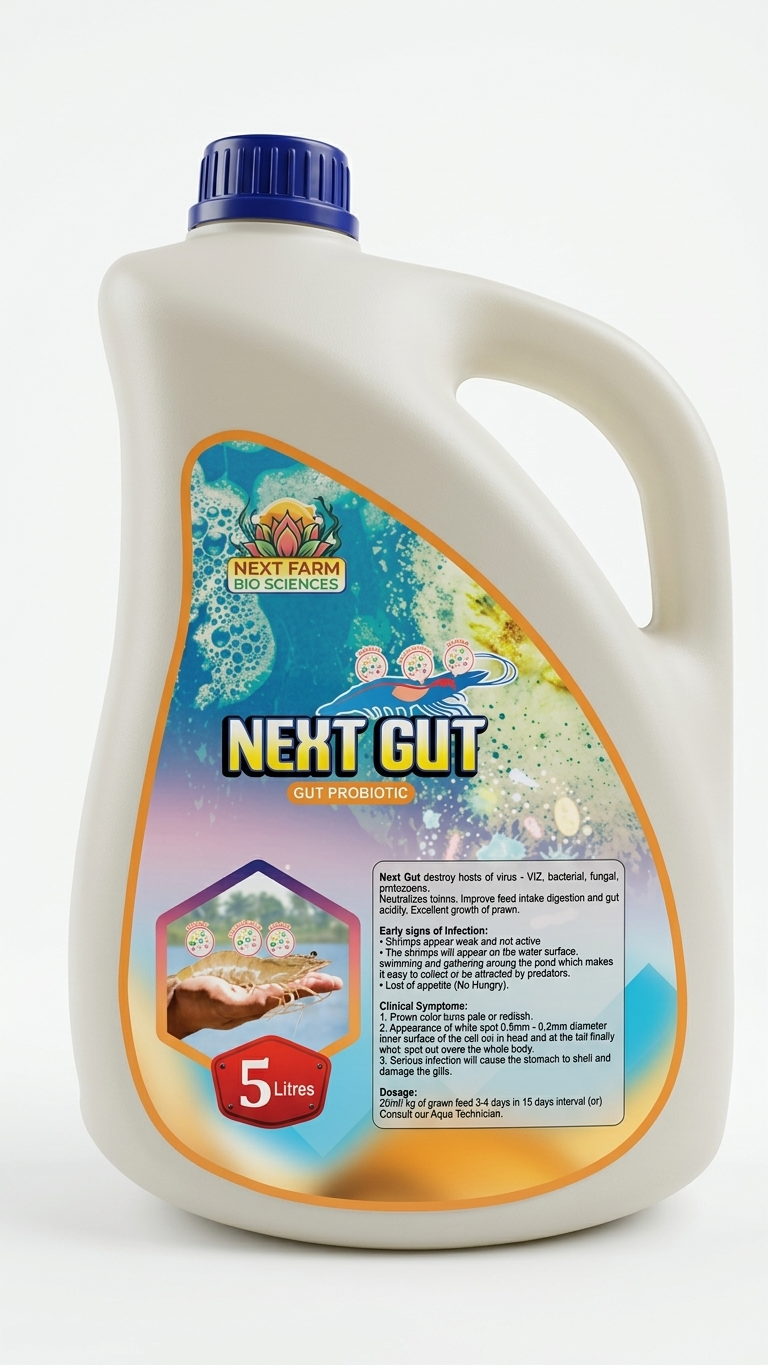
Next Gut (10B CFU/g)
Premier biological probiotic for reversing White Gut and White Feces Syndrome in Penaeus vannamei. Restores gut lining and restarts feeding in 48-72h.
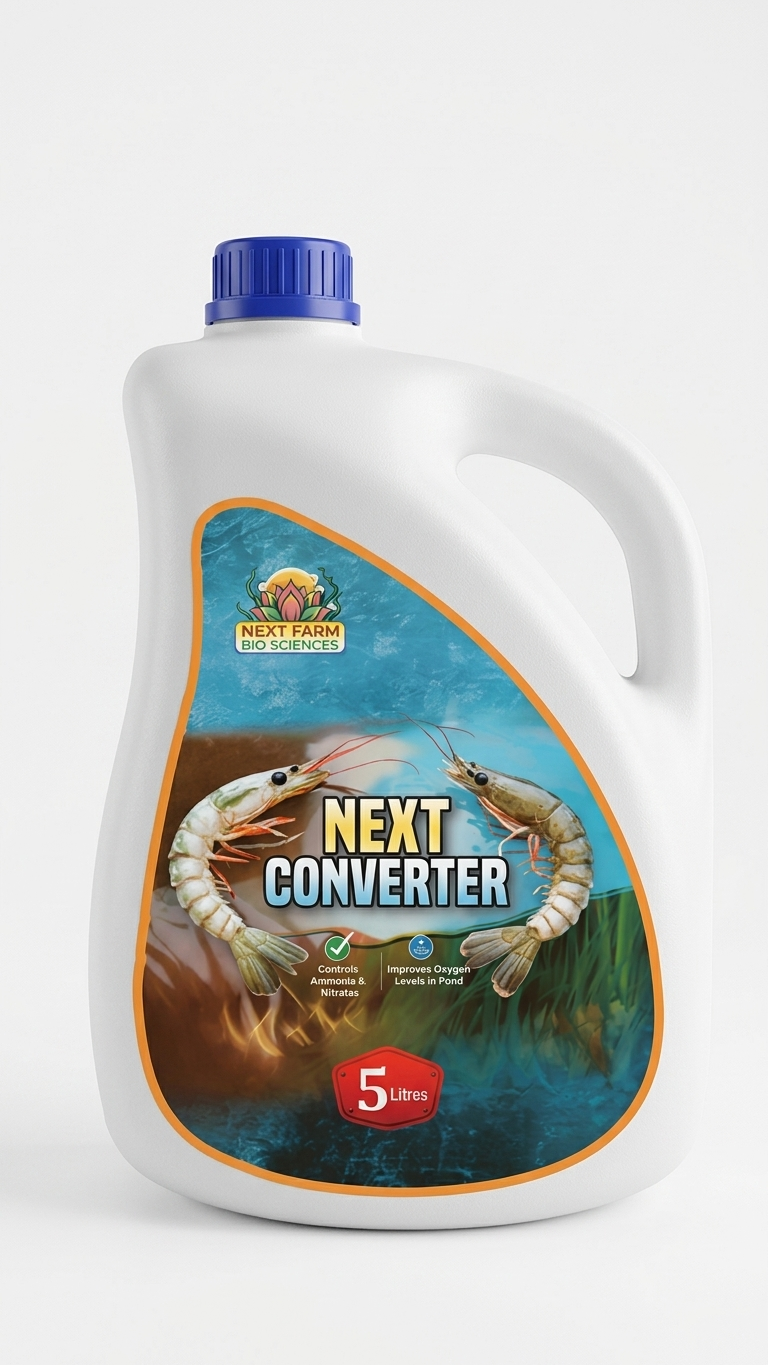
Next Converter (4B CFU/ml)
Pre-activated autotrophic nitrifying consortium that rapidly converts unionized toxic ammonia and nitrite into non-toxic nitrate in 24 hours.
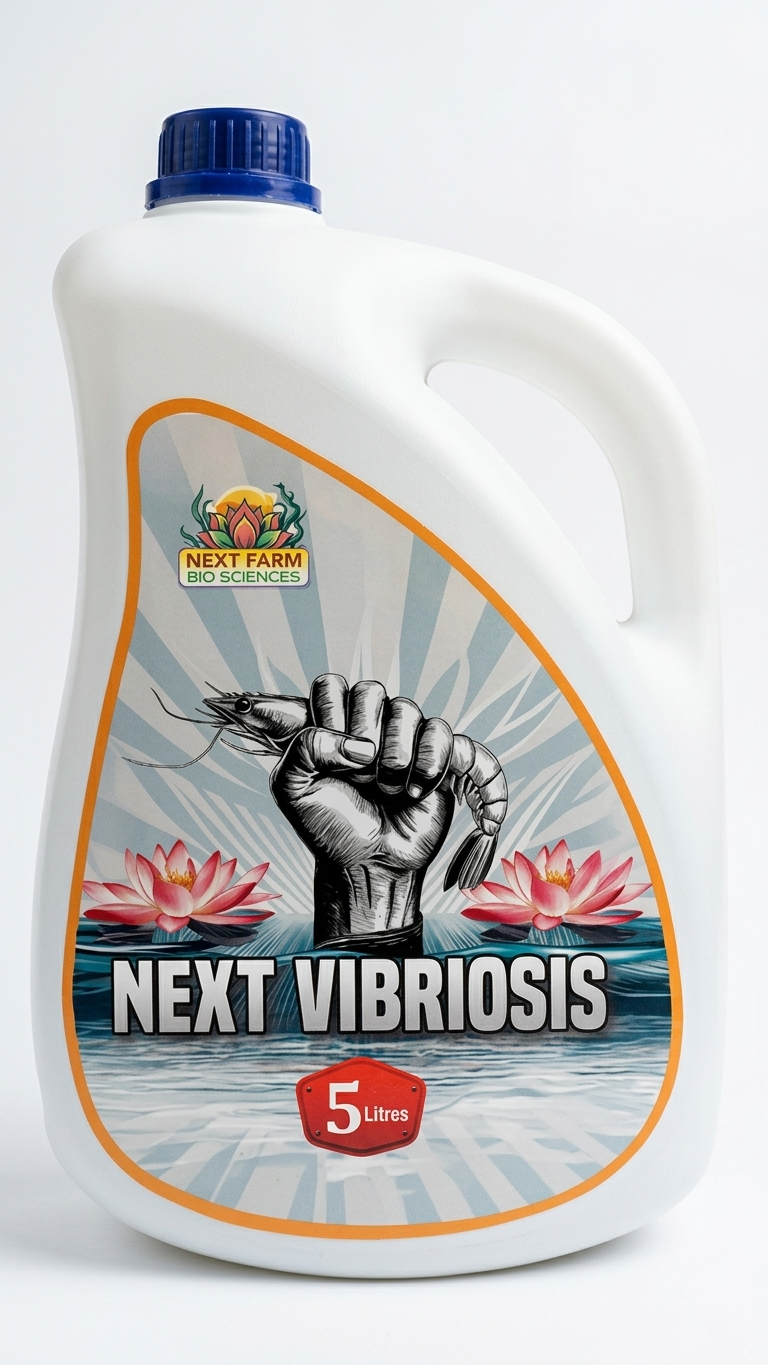
Next Vibriosis (12B CFU/ml)
Potent probiotic antagonist targeting pathogenic Vibrio parahaemolyticus and V. harveyi to prevent Red Disease, tail necrosis, and EMS/AHPND.
ICAR-CIBA & NFDB Standards: Why Biological Probiotics Outperform Banned Chemical Antibiotics
Both the National Fisheries Development Board (NFDB) and the Central Institute of Brackishwater Aquaculture (ICAR-CIBA) strongly advocate for biological disease intervention over chemical antimicrobials in commercial shrimp culture. Under the Coastal Aquaculture Authority Act and MPEDA export guidelines, the use of 20 specific veterinary antibiotics is strictly prohibited in commercial aquaculture in India:
- Chloramphenicol & Nitrofurans: (Furazolidone, Nitrofurazone, Furaltadone) — Zero-tolerance export rejection.
- Fluoroquinolones: (Enrofloxacin, Ciprofloxacin, Nalidixic Acid) — Banned due to severe hepatopancreatic atrophy.
- Tetracyclines & Aminoglycosides: (Oxytetracycline, Neomycin, Gentamicin, Kanamycin) — Prohibited in commercial ponds.
- Sulphonamides & Others: (Sulphamethoxazole, Streptomycin, Colistin) — Triggers rapid microsporidian (EHP) proliferation.
Scientific Reality: Intracellular microsporidian spores (EHP) are completely immune to chemical antibiotics. Using them destroys protective gut villi, causing 100% loss.
- 100% Certified Antibiotic-Free: Fully compliant with CAA, MPEDA, and ISO 9001:2015 biosecurity standards.
- Targeted Antagonistic Strains: Living Citrobacter freundii and Bacillus subtilis produce natural lipopeptides that outcompete pathogenic Vibrio.
- Zero Export Rejection Risk: Guaranteed 100% residue-free for US FDA, EU, and Japanese export consignments.
- Active Intestinal Healing: Rapidly repairs damaged hepatopancreatic tubules and re-establishes firm feeding within 72 hours.
Andhra Pradesh Prawn Farming Hubs: Regional Soil & Water Management Guide
Andhra Pradesh accounts for over 70% of India's commercial Litopenaeus vannamei production. Different coastal districts present distinct soil, salinity, and disease pressures requiring tailored biological protocols:
రొయ్యల తెల్ల పేగు వ్యాధి (White Gut) & అమోనియా సమస్యలు
Heavy black cotton soils lead to intense bottom sludge fermentation. High EHP spore loads trigger severe White Gut between DOC 35 and 60.
విబ్రియో ఎరుపు వ్యాధి (Luminescent Vibriosis) & హై శాలినటీ
High sea salinities (28–38 ppt) and summer heat spike virulent Vibrio harveyi counts, resulting in luminous water and red swimmerets.
లూజ్ షెల్ (Soft Shell) & తక్కువ లవణీయత (Low Salinity)
Freshwater to low-salinity ponds (0–8 ppt) experience severe ionic Calcium:Magnesium ratio imbalances, causing molting cramps.
Frequently Asked Questions About Shrimp Medicine
Scientific clarity on legal regulations, application, and dosage
Why are chemical antibiotics banned in shrimp culture?
Chemical antibiotics (such as chloramphenicol, furazolidone, and oxytetracycline) leave toxic bioaccumulative residues in shrimp tissue. They trigger severe hepatopancreas toxicity, induce antimicrobial resistance in water bacteria, and result in immediate export confiscation and destruction by international regulatory bodies (US FDA, EU, and Japanese health agencies). Next Farm Bio Sciences provides 100% legal, CAA-approved biological inputs that cure disease safely.
How quickly do biological medicines work in pond culture?
Pre-activated living bacterial consortia begin enzymatic activity within hours of broadcast. For water conditions like toxic ammonia, Next Converter lowers TAN within 24 hours. For internal gut ailments like White Gut, Next Gut restores feed uptake and reverses fecal string sloughing within 48 to 72 hours.
Where are Next Farm Bio Sciences shrimp medicines manufactured and shipped from?
All 11 formulations are produced under sterile conditions in our ISO 9001:2015 certified biotechnology laboratories located in New Autonagar, Vijayawada, Andhra Pradesh. Orders confirmed before 2:00 PM are dispatched same-day with express delivery to all coastal aquaculture districts across AP, Tamil Nadu, and Odisha.
Can EHP (Enterocytozoon hepatopenaei) microsporidian spores be controlled without banned antibiotics?
Yes. EHP microsporidia have polar filaments resistant to standard antibiotics. The validated biological protocol combines water biosecurity broadcasting (Next Viro Nill @ 1.5 L/Acre) to suppress environmental spore reservoirs with multi-strain enteric probiotics (Next Gut @ 20 mL/kg feed) to prevent polar spore germination in hepatopancreatic tubules and sustain normal harvest growth.
What is the safe biological alternative to harsh BKC 50 and Glutaraldehyde sanitizers?
Chemical disinfectants like Benzalkonium Chloride (BKC 50%) and glutaraldehyde can irritate sensitive shrimp gill lamellae and crash beneficial diatom blooms. Next Viro Nill provides a biological water-conditioning alternative using high-density antagonistic Bacillus and Pediococcus strains (Minimum 15 Billion CFU/ml) that compete against pathogenic Vibrio without gill damage or plankton collapse.
Does Next Farm Bio Sciences offer Third-Party Contract Manufacturing and private labeling?
Yes. We provide complete third-party contract manufacturing, custom formulation, and private-label bottling for aqua-input brands, distributors, and cooperatives from our Vijayawada facility with low MOQs, ISO 9001:2015 standards, and full CAA export compliance documentation.
Third-Party Shrimp Medicine & Probiotic Manufacturing in India
Next Farm Bio Sciences offers end-to-end contract manufacturing, private labeling, and custom formulation for aquaculture feed supplements, multi-strain probiotics, and water biosecurity sanitizers. Produced in our ISO 9001:2015 and CAA-compliant biotechnology facility in New Autonagar, Vijayawada, Andhra Pradesh.
Low Minimum Order Quantities (MOQ)
Flexible batch scaling starting from trial batches for regional aqua-input brands, veterinary stockists, and coastal farm cooperatives.
Custom Packaging & Bottling
Available in 1-Liter HDPE bottles, 5-Liter industrial canisters, 20-Liter carboys, and bulk drums with custom label printing and tamper-proof induction sealing.
100% Antibiotic-Free & CAA Documentation
Complete Certificate of Analysis (COA), microbial CFU validation reports, and zero-antibiotic lab affidavits provided for every production run.
Speak with an Aquaculture Specialist
Experiencing sudden mortality, check tray feed drops, or ammonia spikes? Contact our technical support team in Vijayawada for guidance on dosage and treatment.